
Behind the Shot
Stories About Our Favorite Photographs in Golf

Elworthy Staging Area
Danville, CA
Photograph by Caleb Bonifay
The good citizens of Danville, California, my hometown located about 45 minutes east of San Francisco, fled to the hills when COVID finally knocked on our door. And when I say “fled to the hills”, I mean in the literal sense, in that everyone took up hiking. It was one of the only activities, besides making god-awful sourdough bread and drinking ourselves into stupors under the guise of “mixology,” that I found myself wanting to partake in. Well, that and golf, of course.
As a result, I decided to take up a golf-hike lovechild of a hobby. It’s a practice heralded by the greatest golfing minds as the ultimate expression of design, yet it has never truly taken root in everyday golfing circles: routing.
Driving along San Ramon Valley Boulevard, a street that serves as a frontage road for the thoroughfare that is Highway 680, my brother Jack (key member of the Subtletees team) and I noticed an open field above us to the west. We’re both used to day dreaming out the window at beautifully empty pieces of land and imagining a green here and a blowout bunker over there, but something about this was different. Between a housing community and the dense forest of the Las Trampas Wilderness lies a 70-acre break of wild grass and grazing cows with an uninhibited view of Mt. Diablo and the entirety of the San Ramon Valley. Our intrigue got the best of us.
Routing a golf course seems elementary to those who have no clue what goes into the process, like baseball fans that label golf an easy game due to the ball lying still in comparison to a 95 mile per hour fastball thrown inches away from your hands. But to those that have found armchairs to firmly rest on within the world of architecture and design, there couldn’t be a more complicated and nuanced practice. Everything from walkability, overall elevation change, and total acreage to the orientation of the wind and the setting sun have to be taken into account. The best routings, widely considered to be majoritively built in the 1920s and 30s, offer a unique sense of cohesion and place.
When we started hiking up the trail, we found it more akin to a potential ski slope than a golf course, the trail at a constant grade of 10 degrees or so. But, as we started to explore in further detail, the game trails came to life. Just like what Bill Coore has practiced for decades, following the trails made by wild game or cattle usually results in the ability to cover any piece of terrain in the most efficient manner. The animals have already figured out how to get from one part of the property to another without taking forever to do so. With this in mind, we began to see that the cattle would maneuver up and down the hillside in a switchback fashion—using the benches set into the hill rather than traversing directly up or down.
This photo shows an example of utilizing one of those benches for a green site. Named “Highway” and clocking in at 180 yards usually into the wind, the hole’s name is indicative of its target line. From the tee, the green gives an infinity-edge feel, blending seamlessly into 680 beyond.
This COVID project soon became my safe haven even after the immediate lockdown, when everyone was still having fun playing board games at home and needlessly buying all the toilet paper within arm’s reach. No stress or anxiety was able to penetrate, no gossip of what the political landscape looked like from down below. Up there, all that mattered was trying to figure out how to make the green-to-tee transition a seamless one. But I couldn’t keep this little tucked-away secret to myself for long. I felt like I had to share it. And I knew just the people to call.
Alex Powers had teamed up with his good friend Taylor Chris to create Wildpar, a media team whose ethos is that golf can be played anywhere, not just on golf courses. Whether it be hitting from ridge to ridge on Mount Tamalpais, overlooking the Golden Gate Bridge, or on bluffs above the Pacific, Wildpar has proven that beauty and adventure are key elements in a great golfing experience. When I told Alex about my idea, I couldn’t believe it when he sounded more excited than I was.
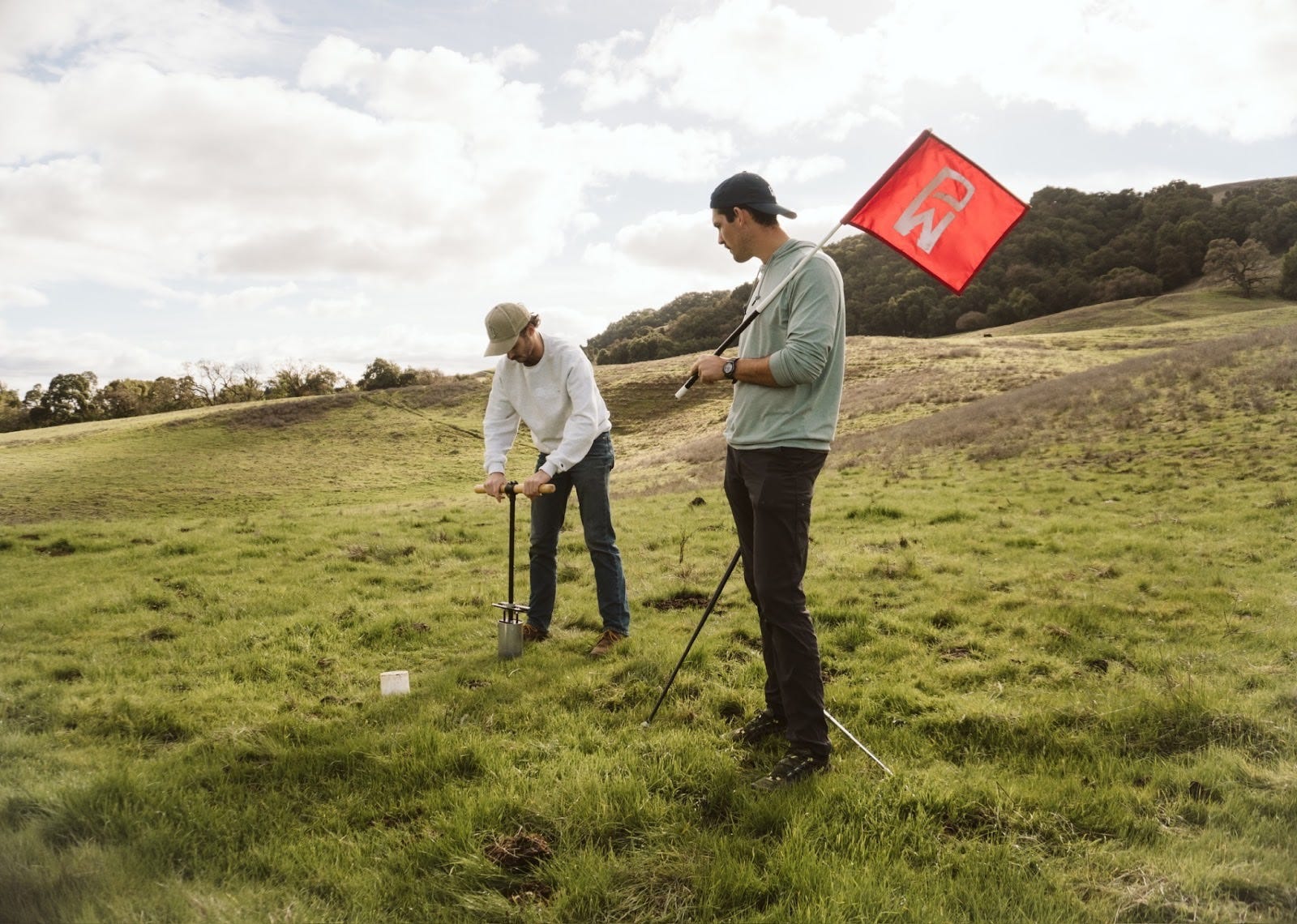
In addition, the photo shows more than me trying to cut into the sinewy, dense clay. It shows the conclusion of almost two years of studying one piece of property with Alex and I finally cutting the very first cup on the property. This resulted in a much deeper appreciation for the great routers of the architectural world.
What MacKenzie, Ross, and more recently Doak and Coore are able to lay out in a matter of months, if not days, has become much more impressive to me. Jack and I were constantly challenged with when to call it complete, when to stop editing and reassessing. The few professionals entrusted with millions of dollars and hundreds of acres to make a client’s dreams come true have honed the skill of “calling it good” down to a science. It’s necessary—they can’t take two years to route every course they get hired to design. Just like professional golfers leaving a legacy with their names engraved on a major trophy, so will their routings be remembered as lasting impacts on the game.
This photo also represents a testament to how much enjoyment we can find when we start to use our imaginations. We never paid a single green fee, yet felt as though we were playing on our very own golf course.
“There’s such a small difference between this and playing real golf. The excitement of hitting a shot to a green with a pin in it is universal,” Jack said when shooting our film, NATURE GOLF: A Collaboration with Wildpar.
So my encouragement to those who are interested in taking another step in architecture and design is a simple one: take a hike.
If you liked this piece, please let us know by tapping the heart button below. It helps more people find our writing. Thanks!

I’ve daydreamed about this very thing on some properties I pass regularly. It’s so cool that you actually did it!